
‘Early is punctual, on time is late.’ I’ll say that again because it takes a couple of goes: ‘Early is punctual, on time is late.’ He literally redefined the meaning of two words to underpin his own obsession with being on time.
That’s Geoff Norcott describing his dad, whose “punctual” pushed Norcott into studying hard for a good grade at university. I really enjoyed his book “Where Did I Go Right” https://www.amazon.co.uk/Where-Did-Go-Right-Left/dp/1913183432 , but I also wasn’t going to be late to my interview with him.
Having Ellie Howe there helped calm my stress, as did practicing combative questions with Serena De Morgan. None of them came up, Geoff was quite kind, and focused on what patient records meant for patients. It was also handy listening to Tom Whicher’s interview as he gave short answers, whereas mine are usually too long. Finally, a hat tip to Tim Allen and the team for looking after me and Ellie.
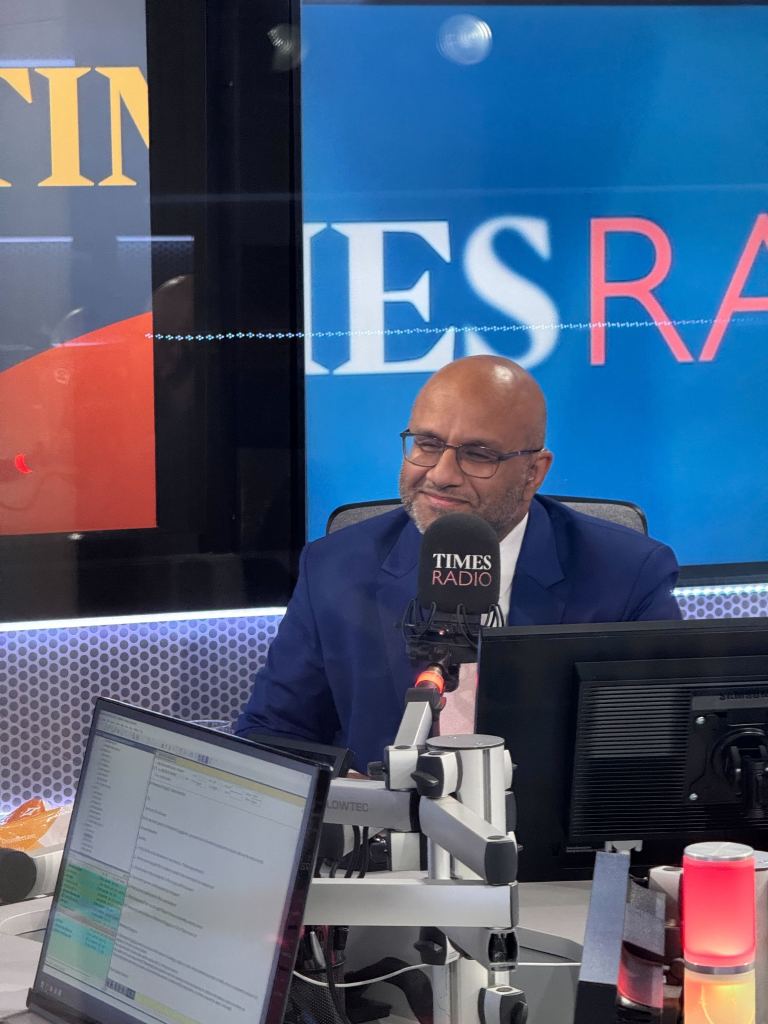
I hope you enjoy listening to the interview below. Geoff gently probed about NHS quality, professionals’ attitudes and personal responsibility when he tried to understand medical records. His book was very funny but also warmly written, including parts on the health and deaths of members of his family. I highly recommend it.
Transcript is below:
Geoff: As it’s Friday night with Norco, with me, Geoff Norcott on Times Radio, and it is now time for our regular CEO of the week. And this week we’re joined by Dr Mohammad Al Ubaydli, who’s giving power back to the patients by giving them access and control over their records. Welcome to the show. Mohammad, thank you. Okay, so first up, tell us more about your social enterprise patients know best. Tell us how that works.
Mohammad: So software that lets you have your entire health information, your GP, your hospital, connect your device, track your information. The idea is just that you understand your health and you know how to look after yourself, as well as give your information to other people looking after you, like hospital, doctor and A&E
Geoff: I think it’s one of the things that anybody looking into our health service, which we, of course, contractually obliged to say, is the best thing that’s ever happened. It is a good thing to have free health care. However, a lot of people would look at the fact that each individual trust, like the fact that all that information isn’t combined in one place. Why haven’t we reached this point yet?
Mohammad: Oh, it’s not just the UK with the NHS, you find it in the States. You find it in every other country. The real problem is all the advances in medicine come from specialists who get more and more specialists now, a surgeon, a heart surgeon, a children’s heart surgeon, and as they get more specialized, they slice up your record into smaller and smaller bits. And so the only way to connect it back up is if the person who goes to all the appointments, the patient has it all with them. But that is a feature of all healthcare systems.
Geoff: How draining can it be for somebody who’s very unwell to have to repeatedly tell the story of their illness every time, like they’re starting again?
Mohammad: It’s not just tiring, it’s also frightening, because you’re worried, if I don’t tell you the bit that matters, might you treat me in the wrong way? Might something bad happen to me? And of course, the sicker you get, the less able you are and more dangerous the situation is. It really is draining.
Geoff: Is there? I mean, maybe I’m being cynical here. Is there a degree to which various NHS Trusts do not want to work together, do not want to integrate their data?
Mohammad: I think all organizations have problems in cooperation, but I will say that my research started in states, and in the States, they actively did not want the person to have their information, because if they walked out the hospital with the information, they could walk with the next hospital and give their money to that hospital.
Geoff: That is shocking. I mean, I think anybody listening would just think that that is really dismal, not least because of how cynical he is, but also because it’s your information. It’s your information. I mean, when it comes to your body, it’s literally your body. How does an industry end up in that place?
Mohammad; I think the healthcare industry in general is dysfunctional around the person who benefits isn’t the one who pays. And we want it to be that way. If you’re sick, we want you to not worry about money, but along the way, bad incentives pile up. The UK with the NHS for all its many difficulties that we all experience, when I was starting in 2008 I thought the one country that could crack this first is the UK, because they have the opposite incentives to the US hospital wanting to lock up your data, to lock in your custom so I was trying to ask the question
Geoff: I think listeners, we think in this point is exactly how does this work? So the idea is that the patient ends up with all of their information and is able to present it variously to all the bodies that need it. How does that happen? How do you draw down the information from the NHS? How cooperative are they with you?
Mohammad: There’s a couple of ways. First of all, your GP information. You can just register for a free of charge. Give us your permission, and we’ll just pull the information from your GP straight away, without taking up your time or your GP’s and we’ve just done it nationally. But then the hospital information is more complicated, a lot more nuanced, so we work directly with the hospital so that they release everything to us immediately, automatically. So about 2 million appointments a month, 20 million test results a month, that kind of thing. What we’re trying to do is make it automatic and easy for the patient and the hospital.
Geoff: I mean, how did you end up getting into this? Were you drawn to this? Was it? Was it a business idea, or was it sort of a personal motivation?
Mohammad: I started it be honest for my mum, so I’ve got a rare disease, and I grew up with my mum fighting to protect me. That meant fighting to get the right diagnosis, fighting to get the right treatment, sometimes fighting me to make sure I took the right treatment. And then I grew up and trained as a doctor, so I saw from the other side, and then I’m also a bit of a geek, so I trained as a programmer. So I thought I could write software that allows the doctor and the patient to work together, for the patient to look after themselves, or for the patient to get safer care. That’s how I got obsessed with it in the beginning.
Geoff: Do most people not sort of have any idea of what’s on their record? I mean, if you used to give me my record now, do you feel confident that there would be stuff there that I’ve been flabbergasted by that just wasn’t, simply wasn’t aware of
Mohammad: Unfortunately, yes, I’m confident you wouldn’t know what’s in your record. And that’s not just you know, annoying for you. It can be dangerous for you and for your doctor as well. When I started in Great Ormond Street Hospital, one of the doctors just sent out five letters through patients their best to the children she was looking after, and she called me next day and said, ‘I sent five letters. A mum wrote back to me, saying there’s an error in the letter. And she said, I’ve been a consultant 15 years. No one had corrected me. I know there’s errors, but no one’s corrected. No one’s made it easy.’ And then she said the most important thing, said, ‘what else can I send? The more I send out, the more they can find and fix the problems with me’, you saw the patients as part of the team. Together we’re working to improve that safety, improve that health.
Geoff: I mean, is there a degree to it? You know, not in the COVID inquiries, and people didn’t want to reveal all the WhatsApps because people regretted saying certain things, particularly going back a while. Is it possible that GPs would have said things about you on your record for other GPs to read that possibly weren’t that complimentary, and I’m not saying that necessarily were mean or toxic, but they might have felt that you’re a bit of a hypochondriac or or something like that. Or is it possible that those two kind of things would exist on one’s record?
Mohammad: I mean, I can tell you, when I was working in medical school, there were things like that in the notes, but over time, people knew that that would be, you know, under the EU, GDPR, you would have to show the information. People stopped doing that. So now people aren’t so much worried about saying something rude or mean. It’s more worrying about well, if there is an error, will you thank me for showing me the error and fixing it? Or will you hate me for making an error. And what most doctors don’t know is that most patients are actually thankful they want to be part of the process. But you go through medical school being told that you have to know everything, you have to do everything, and if you’re not, you’re a failure. And with that attitude, you’re a bit worried about and anxious about the patient seeing information.
Geoff: What would be, in your view, the most common thing that would be on somebody’s record that they’re not aware is there.
Mohammad: Sometimes they’ve got medication that’s wrong, sometimes they’ve got a diagnosis that’s out of date, and sometimes there’s missing information the patient knows about that hasn’t made it in the record, that would completely change the right medication combination for the patient. So I always say to patients, just make sure you get the information you’re helping your doctor as well as helping yourself.
Geoff: So in terms of how you start a business like this, I mean, who, who do you? Do you have to go and get funding? De Do you have funding rounds? Is that? Is that? Is that? How is that the very first process? I’m thinking, people are inspired to do something, yes, meaningful like this. Like, what is the very first step?
Mohammad: So for us, it was the founders. We put our savings in. I’ll be honest with you in the beginning, although everybody thought this was a correct, amazing thing to do, everyone also had all the evidence this was a completely mad idea. It would never work. There’s no point wasting money on it.
Geoff: Why did they not think his work? What was the biggest reservation?
Mohammad: Because what they knew from all the healthcare systems dysfunctions is that the entire system is arranged against the information going with the patient, for, you know, a variety of reasons, but they just said, no one will agree with you, but by the way, it’s a stupid name. You’re gonna annoy all the doctors. So from that beginning, the idea didn’t look like a goer, but what we actually did on the ground is actually there’s a whole bunch of doctors who are very concerned about their patient safety, would love to do that, and you just have to go behind the scenes, quietly, find them, work with them, and it’s a privilege to find them, but you just have to do it low key and low budget in the beginning.
Geoff: So you mentioned the name
Mohammad: Susan hills and Great Ormond Street Hospital.
Geoff: The name of the product itself?
Mohammad: It’s patients know best?
Geoff: Is that? So is that what you thought would irritate the doctors?
Mohammad: Yes, I thought it probably would. In my defense, we’re not saying that patients do know best, although many of them do. I’m saying it’s my job as a social enterprise to deliver a patient who knows best. I’m going to give them all the data, explain what it means, and train them up in the same way that my nurse trained me how to inject myself, and that wasn’t just great for me, being empowered. That saved the NHS money and it saved my doctor, it saved a whole bunch of work for everyone. So we’re on the same team, but you’ve got a mindset shift where you think the patient actually does have abilities and you want to work with them.
Geoff: It sounds like your philosophy slightly veers towards a personal responsibility type sort of framing, is that fair? I mean, that’s not. That’s not a bad thing is that you believe that people will be the best judges of what they need in terms of health care.
Mohammad: I think more about personal abilities. People underestimate what they can do. People underestimate what patients can do. But on the flip side, if you look at the majority of healthcare spending, it’s on things like diabetes, heart disease and so on, where what the patient does matters a lot more than what the doctor does. Therefore, it is your responsibility to understand what’s happening, track what needs to be done. You can’t do everything. You’re not going to operate on your appendicectomy, but for a whole bunch of other stuff, what you do matters, and you should do it. You should pay attention. Geoff: Thank you. You, I don’t think anyone said you got very reassuring voice.
Mohammad: Thank you.
Geoff: Incredible bedside manner. I’d like, I’d like, to invest me. What is the potential here? Is this, is this going to be something that makes you very rich, or is it just, is it just the sort of public service element of it that gets you out bed?
Mohammad: I mean, we started with social enterprise from the beginning. What we think about is that everybody in the world gets to benefit. So it’s not just 1% of population with a rare disease or 20% with long term condition. It’s everyone. And it’s not just the UK. We started working in Africa last year. It really is bringing this to every person in the world. Just they have abilities you want to give them that just in the same way that my doctor and nurse train me, I’d like everybody else to have that,
Geoff: okay, thanks very much for joining us, that was Dr. Mohammed, who is the CEO of patients know best.
Discover more from CEO blog at Patients know best
Subscribe to get the latest posts sent to your email.
 CEO blog at Patients know best